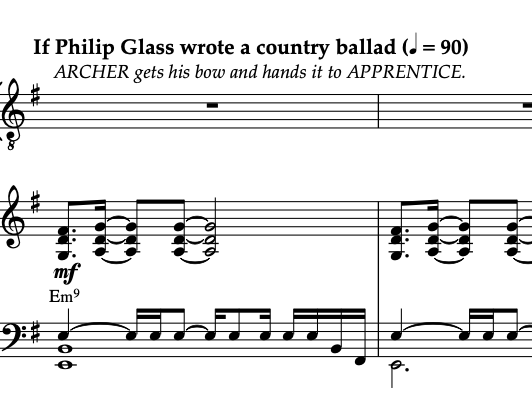
In my breakdown of "You Go", I talked about my approach to unusual metric schemes. Because I personally have such a strong physiological reaction to groove and rhythm, I tend to think of meters as, implicitly, tied to the circadian rhythms of the characters. I hear the underlying pulse as a heartbeat, or a gait, or a communicative flow. "Jade Rabbit (Mercy)" takes this idea to its most extreme. Though the core of the song is nominally an ABAC (I'm a sucker for traditional forms, even in unusual contexts!), once the beat kicks in, it takes 17 bars until the same meter occurs two measures in a row. You can see 4 different meters in 6 bars below:
Sunday, May 24, 2026
On "Jade Rabbit (Mercy)"
Magpie's Song visual references
I found these pictures before the first production of Magpie's Song at Yale, to serve as common visual references and inspiration as I continued to develop the score. These images were compiled in the early days of AI, just as the technology was beginning to produce sophisticated, realistic images but before it was common practice to screen for AI when sourcing art. I hate AI, and I'd never platform it, nor do I give anyone permission to platform my art in any sort of conjunction with AI-generated material; I take this as a historical artifact.
MAGPIE + THE SHOW
THE LOVE STORY
THE WAR STORY
THE MONSTER STORY
Thursday, December 18, 2025
On "It's Coming Down"
This song was, in small part, inspired by "The Western Wall". That number culminates in full-throated rock counterpoint, complete with an electric guitar soloing over not one, but two riffing vocalists. When I first saw the piece, I remember that musical climax pushing me right to my saturation point, and relenting right when I felt I couldn't take in any more information.
"It's Coming Down" was an exercise in pushing past that point, and accessing total musical overwhelm as a dramatic affect. The counterpoint is too dense with layers for the audience to grasp; the richness and dissonance of the texture makes it impossible to catch anything more than fragments of lyrical and melodic information. Just when the ear has had enough, the counterpoint muscles forward with renewed ferocity as the band slams out huge stabs, a thundering heartbeat. The effect is totally disorienting and overwhelming, and simulates for the listener how Archer is trying, and failing, to "block out the noise". In the heat of the moment, he can't center himself, so neither can the audience's ear.
If Johann Joseph Fux were alive to hear this, he'd have a heart attack, which delights me to no end. Dramatic music affords the adventurous composer the freedom to pursue musical ideas that wouldn't hold up to standards of clarity and cohesion in a piece of concert or pop music.
When I was looking for visual references for Magpie's Song, I found this painting of Hou Yi shooting down the suns. I loved the imagery of the Emperor's sons being birds, and the undeniable pile of broken bodies accumulated in frame. This idea never found its way into the show, because the sons being birds gets confusing when Vega is a human woman, but the image has always stuck with me, so I wanted to share it here.
"Just hold on tighter to keep my hands from shaking..."
Tuesday, December 9, 2025
Art on Art
In no particular order, a living list of my favorites:
FICTION
If On a Winter's Night a Traveler (particularly Chapter 8), Calvino.
Josephine the Singer, or, the Mouse Folk, Kafka.
ESSAYS
The Birth of Tragedy, Nietzsche.
Letters to a Young Poet, Rilke.
The Origin of the Work of Art, Heidegger.
"The Storyteller", Benjamin.
MUSIC
Lempicka (particularly "I Will Paint Her" and "Just This Way"), Gould + Kreitzer.
"Finishing the Hat", Sondheim.
"Now Feels Bigger than the Past", Stevens.
Preludes, Malloy.
OTHER WORKS
Faust, "2. Prelude on the Stage", Goethe.
Ramon Subercaseaux in a Gondola, Singer Sargent.
If you'd leave your favorites in the comments, I'd love to seek them out. I adore art on art.
Sunday, August 3, 2025
Dinner with a broadway composer
The other day, I was fortunate enough to cap a summer spent working as an intern/assistant to a broadway composer I'll leave unnamed with a dinner, where I asked them all the questions I had about life as a professional songwriter for musical theatre. Here are some of the most valuable things they imparted, the sorts of things I'm glad I had someone tell me instead of learning the long way 'round. I write this in the spirit they brought to the dinner: the will to share the factets of building a life in musical theatre it's hard to teach, or talk about.
A lot of our conversation was them explaining the mechanics of three levels of theatre-making: off-off-Broadway, off-Broadway, and Broadway.
OFF-OFF-BROADWAY.
The world of day jobs, where everybody starts. There's no commercial producers, and no money. Theatre spaces will pay you hundreds of dollars, at most, to put up your pieces, and they're run by one or two people, so getting them to know you and your work is the way you get your foot in the door.
These small theatres are good sites to mount productions, but so too are concert spaces- Joe's Pub is on the high end, but spaces like it could entertain concert productions and readings.
All spheres of theatremaking rely on personal connections, but the preprofessional/early professional space especially so. This is alarming to a strange bird introvert like me, who finds many interactions difficult to navigate and draining. Two things this composer said about their experience reassured me: one, that everyone in the theatre world is a little strange, so any fumbling I would feel inside my skin would get lost in the noise, and two, that it took them years and years to meet his closest collaborators. It was a decade or so into their work in the theatre to meet a director collaborator they've worked with on 3 of their shows, for example. I hope those observations are as reassuring and galvanizing to you as they were to me.
OFF-BROADWAY.
Off-Broadway is the world of commission work. An off-Broadway theatre, like the Signature or MCC, will pay you a flat fee- a little less than a year's wages for "a year's work" (it takes about a year, if not less, for them to write a show, so their year counts for more than the rest of us). The good news: if your show is a commercial bomb, you're still paid the same. The bad news: if your show is a commercial smash, you're still paid the same. Your revenue comes exclusively from the commission.
The people who will be securing you these commissions on the institution's behalf are artistic directors; they're who you're going to want to ensure you make a connection with in order to get your work developed and produced at a professional standard.
BROADWAY.
Usually, getting to Broadway looks like a producer "swooping in" on a show and buying its rights. For about five years, as the show continues to be developed, you don't see money for it, even up through the production process for Broadway. Then, once the show opens, you get a healthy cut of the box office royalties.
Big productions abroad pay similarly well to Broadway royalties for the duration of their runs. Licensing rights from smaller productions are individually insignificant; a show has to be produced a fair bit for it to be an appreciable source of income instead of a respectable cushion. Fiscally speaking, having a show stay open on Broadway seems preferable to a hit on the community theatre circuit seems preferable to a show that the musical theatre intelligentsia drool over.
BEYOND BROADWAY.
I was surprised by how open this composer was talking about writing with commercial ambition. Because I characterized them as a more artsy, experimental writer, it was a shock to hear them say they modeled the structure of one of their flagship shows off of Les Mis, and wrote it with Broadway ambitions from the start, though they were still working well off-broadway at its inception. They talked about how a show of theirs with a cast of 4, virtually no set, and low barrier to musical entry was one of their most popular shows on the amateur theatre circuit. They contrasted this with pieces they've written that demanded virtuosic singers and performers, and pieces that were intensely personal and linked to recent events. Those pieces never find the same foothold after their flagship productions, and they don't contribute significantly to this composer's income.
I'd also noticed this tendency towards actively working to make pieces produceable in Adam Guettel, who originally orchestrated Light in the Piazza for piano trio (though that didn't last), and deliberately wrote Days of Wine and Roses for two and a half singers. It seems to me that the more one's tendencies skew off the beaten path, the more actively one needs to think about steering one's pieces back towards being feasible to perform and stage on the community theatre level. After all, that's the stage on which pieces find their longevity, audience, and sustainable profit, all the things you want as a career artist.
PARTING NOTES.
An agent shouldn't start your career, but join your career. When you get to the point where it would be useful to have someone to advocate and negotiate on your behalf with institutions and producers, or read contracts with you, talk to theatre artists you admire who are doing what you want to do and ask who's representing them. That'll point you towards where you need to go.
This composer recommended to me the book "Song of Spider-Man", by Glenn Berger, the second bookwriter hired to fix "Spider-Man: Turn Off the Dark". We were talking about how quotidian the day-to-day of writing and developing a Broadway musical seems to be, and they said that book described that tension well. When I get around to reading it, I'll be sure to post about it.
Tuesday, July 22, 2025
On "Archery Lesson"
This song is built off of one of my favorite lyrical techniques, one I intend to talk about more later (probably with "Light's Returned" or "Follow the Spark"? we'll see), where the one lyric is given multiple meanings by the dramatic context. In this case, the lessons double as Archer mentoring Apprentice through dealing with grief, trying to lead him to a place of stability and peace in a language Apprentice would actually listen to.
I needed a backbone to structure the action, so I came up with the idea of Apprentice getting one shot per day. Later, I learned of a telling of the original myth where Hou Yi outpaced Peng Meng in a contest shooting geese; I wish I had heard of it before I started writing the song, so that I might have built it around this contest instead of contriving my own variation on the myth, but I'm very satisfied with how it turned out.
When I was finding the musical material for this song, I built myself a short playlist that captured the world I wanted it to live in. Those songs were:
- "Over", JRB (the acoustic elegy I had been looking for from the start)
- "Morning Dew", Grateful Dead
- "Evol", Adrianne Lenker
- "Rosanna", Toto
- "Hold the Line", Toto
- "Higher Ground", Stevie Wonder
- "Fool in the Rain", Led Zeppelin
- "El Sapukai", Tierra Adentro (can't speak to the lyrics; hope there's no slurs, etc.)
Friday, July 18, 2025
On "Make This World Better"
BROTHERS, SISTERS, I KNOW HOW YOU FEEL
MISTREATED AND BROKEN, CRUSHED UNDER LIFE’S HEEL
I’M ONE OF YOU, I FEEL YOUR PAIN
LEND ME YOUR EAR AS I SING MY REFRAIN...
WHEN I FIRST CAME TO TOWN I MET A MAN
WHO USED TO MAKE A LIVING OFF MANURE,
WHEN DROUGHT KILLED CROPS, HE KILLED HIS ANIMALS,
SO NOW HE AIN’T GOT SHIT AND HE’S DIRT POOR
(I ended up reusing that joke in "Ten Suns". Nothing else from this song survives to the show.)
I’VE SEEN HIS KIDS, THEY’VE RESORTED TO CRIME,
STEALING TO BUY THEMSELVES TIME
ARE THESE THE FOLKS YOU WANT TO MEET?
IS THIS THE WORLD YOU WANT TO SEE?
THE GROUND HOLDS FIRE TO OUR FEET,
YOU ALL ARE LUCKY YOU HAVE ME!
LIKE IT OR NOT,
IT’S TOO DARN HOT!
This version of the War Story was quite rich, particularly the decision whether to shoot the final sun. On the one hand was the Demagogue, who was exerting fascistic pressure and appealing to Archer's sense of civic duty as a soldier. On the other hand was Wife, pregnant, impelling Archer to confront and empathize with the Emperor's fatherhood. The more I worked with this adaptation, however, the more I was confronted with the essential storytelling question of "why". Nothing beyond fiat drove Demagogue into the story, or motivated his action, and so nothing Demagogue did felt like it had weight or legs.
One of the reasons I set out to write a mythic adaptation is because I could guarantee that my source material really worked. In a few short lines, myths and fables establish world-sweeping stakes and test the extremes of human emotion and psychology. If I failed to musicalize them, dramatize them, make them compelling, the failure was on mine as a craftsperson. At times like these, when I had written myself into a corner and imposed myself too strongly on these stories, I made pilgrimages back to the stories. Without fail, the answers were always there the whole time, and stripping away my contrivance helped the stories speak in all their compact clarity and infinite depth.
It was just so with the War Story. Starting virtually from scratch, I made Demagogue back into Apprentice and removed the pregnancy. This made the piece cleaner and gave it a much-needed sense of direction in the Apprentice's psychological transformation. The song spot once occupied by "Too Hot" now became an ideological confrontation between the idealistic Apprentice and the jaded Archer. And once I had that situation, I had "Make This World Better".
Well, that's not true. I wrote one really shitty, overly abstract and poetic draft at that song spot before this one. But "A Soldier" is long since lost to the back woods of Google Drive, as it deserves to be...
On "Without You"
I hold the idea of leitmotifs at arms length. I understand the dramatic appeal, but I often find its execution, as a composer and a l...
-
For much of Magpie's Song's development, the War Story was a much looser adaptation of the myth of Hou Yi , Feng Meng , and Chan...
-
The other day, I was fortunate enough to cap a summer spent working as an intern/assistant to a broadway composer I'll leave unnamed...
-
This song is built off of one of my favorite lyrical techniques, one I intend to talk about more later (probably with "Light's ...